righthook app icon: a white hook ending in a glowing amber dot on a dark background

righthook for Mac

Plug in. Lights out.

Keep your MacBook open and its built-in display off while an external display is connected. Touch ID, the keyboard, the trackpad and the camera stay yours. Unplug, and your built-in display is back before you look down.

Coming soon to the Mac App Store

See how it works

For MacBook Air and MacBook Pro. macOS 14 Sonoma or later, including macOS 26 Tahoe. Apple silicon and Intel.

  • No data collected
  • Sandboxed
  • Crash-safe
  • No special permissions
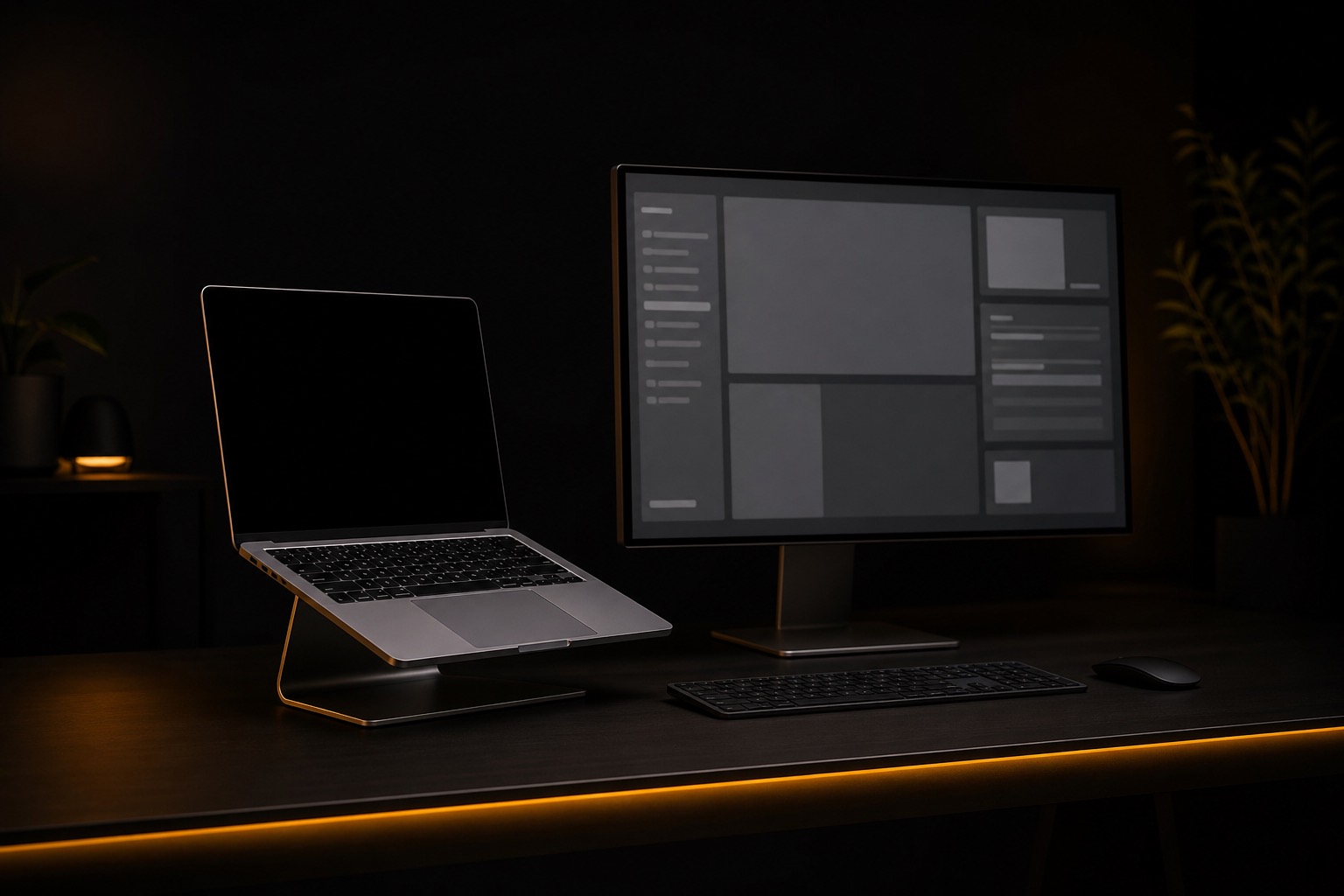
A desk at dusk: an open laptop on a stand with its screen dark, beside a large external monitor that carries all the work.
One light on. The screen you’re looking at, and nothing else.

The problem

Every workaround costs you something

You plugged in a big display so you could look at one screen. Your MacBook keeps glowing next to it anyway, and macOS gives you three ways to deal with that. Each one takes something away.

How righthook compares with the usual workarounds
What you keep Brightness to zero Mirroring Close the lid righthook
Built-in screen out of your eyelineMostlyNoYesYes
Windows and cursor stay on the screen you seeNo, they wander onto the dim oneShared, often at the wrong sizeYesYes
Touch ID, keyboard and trackpadYesYesNoYes
Built-in camera for callsYesYesNoYes
Undoes itself when you unplugNo, you turn it back upNo, you switch it offYou open the lidInstantly

How it works

The whole product, in four beats

  1. Plug in.

    Connect your external display. righthook notices.

  2. Lights out.

    A moment later your built-in display goes dark, and your windows and cursor live on the display you chose.

  3. Unplug.

    Disconnect, and righthook doesn’t wait.

  4. Lights on.

    Your built-in display is back the instant the cable leaves. Nothing to set up again.

What you keep

Lose the glow. Keep the laptop.

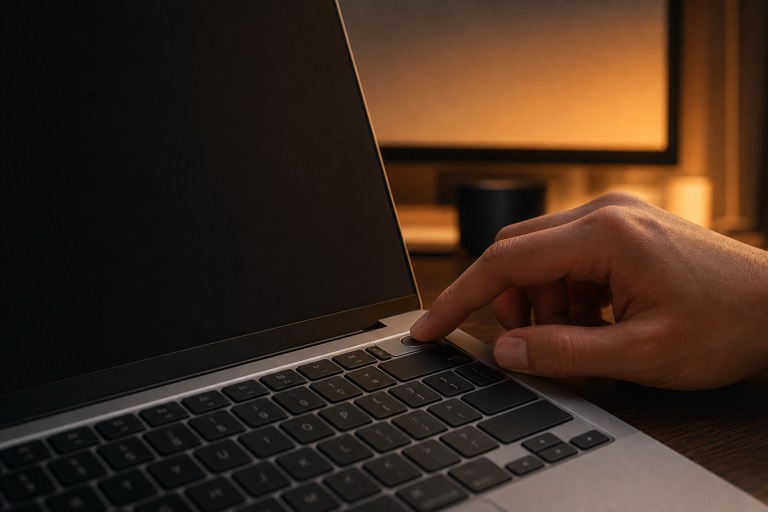
A finger on the fingerprint key of an open laptop whose screen is dark, an external monitor glowing behind it.

Unlock with a fingertip, still.

Closing the lid takes Touch ID with it, so every password prompt, unlock and Apple Pay check turns back into typing. With righthook the lid stays open and only the display goes dark. Touch ID, the built-in keyboard and the trackpad you like all keep working, right where they are.

Keyboard. Trackpad. Touch ID. Speakers. All still yours.

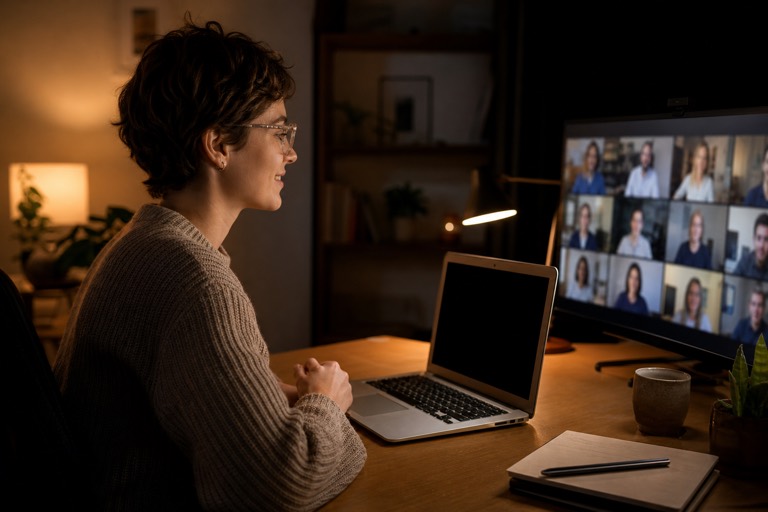
A person on a video call at a desk. The laptop in front of them is open with its screen dark; the call fills the external monitor.

Take the call on the camera you already have.

The built-in camera only works with the lid open. righthook keeps it open, so you can join a call on the camera in your MacBook while the call itself, your notes and everything else live on the big screen. No second webcam to buy, no glowing panel in the corner of your eye.

Lid open means the built-in camera stays available.

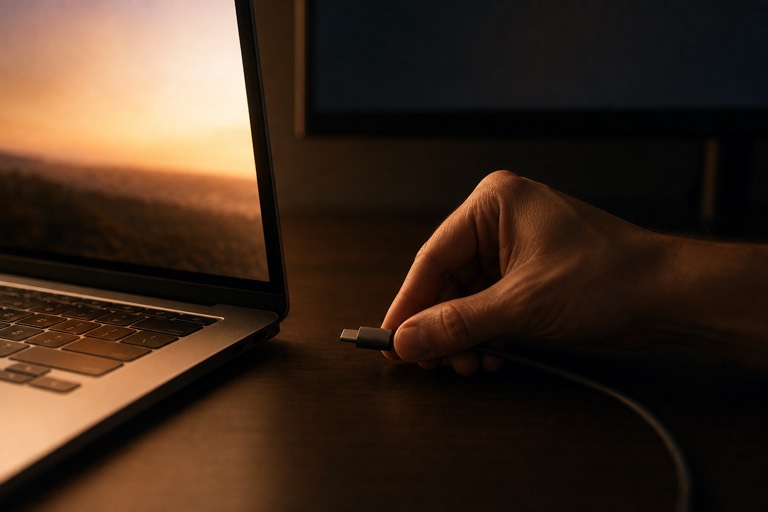
A hand pulling a cable from an open laptop as its screen lights back up and the external monitor behind it goes dark.

Grab it and go.

Pull the cable and your built-in display is back in the same moment. No setting to flip, no brightness to dial up, no hunting for windows. Turning off waits a beat for your displays to settle; turning on never waits. Come back to the desk tomorrow, plug in, and it does it all again.

Copes with lid open and close, sleep and wake, and switching users.

Safety

Built to fail toward a screen you can see

Turning off a display is only useful if you can always get it back. righthook was designed around that one rule, and tested against it on purpose.

Sight Check

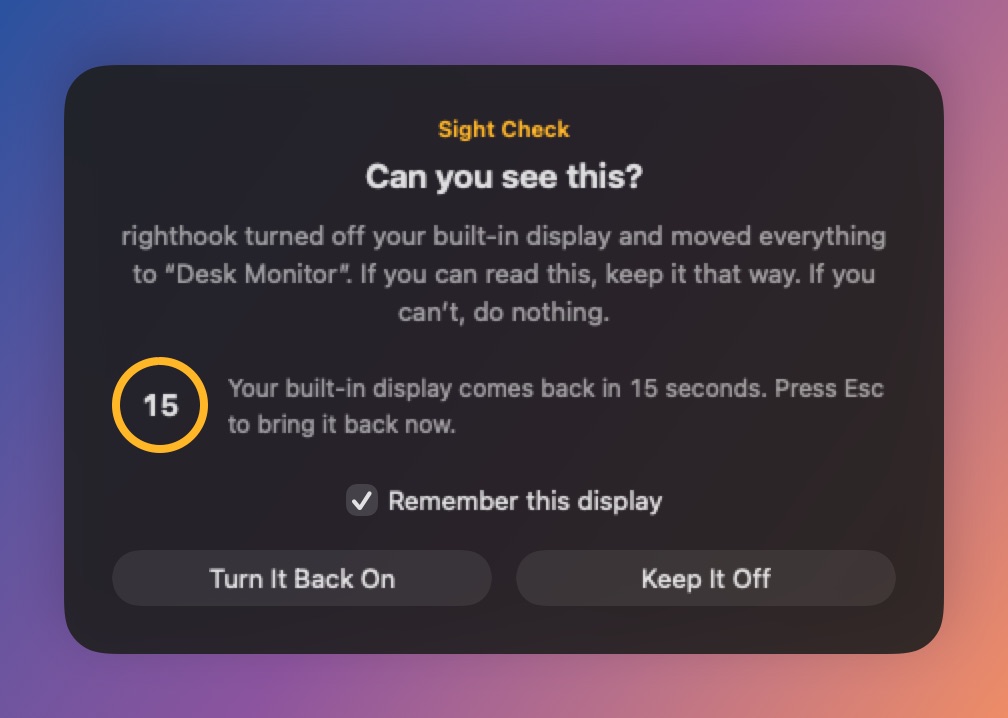
The first time a new display would take over, righthook asks “Can you see this?” on that display, with a 15-second countdown and no default button. No answer, and your built-in display comes back by itself.

Comeback

One shortcut brings your built-in display back from anywhere: Control-Option-Command-D. It doesn’t need you to see or click anything, and it doesn’t need Accessibility permission.

Crash-safe

If righthook ever quits or crashes, macOS itself lights your built-in display back up, because the setting righthook uses ends with the app. We test it by force-quitting the app with the display off.

Presenter-safe

When your built-in screen is being mirrored to a projector, TV or AirPlay, Automatic stays out of the way and leaves it on.

Calm with flaky cables

A connection that keeps dropping pauses Automatic instead of flickering. And if the external display goes dark on its own, everything is restored at once.

Your setup stays yours

Mirroring you set up yourself is never undone; righthook only reverts what it created. Pick which display takes over, and tell it to ignore the TV you plug in now and then.

See it

Small, plain and in the menu bar

Real screens from the app, not mock-ups.

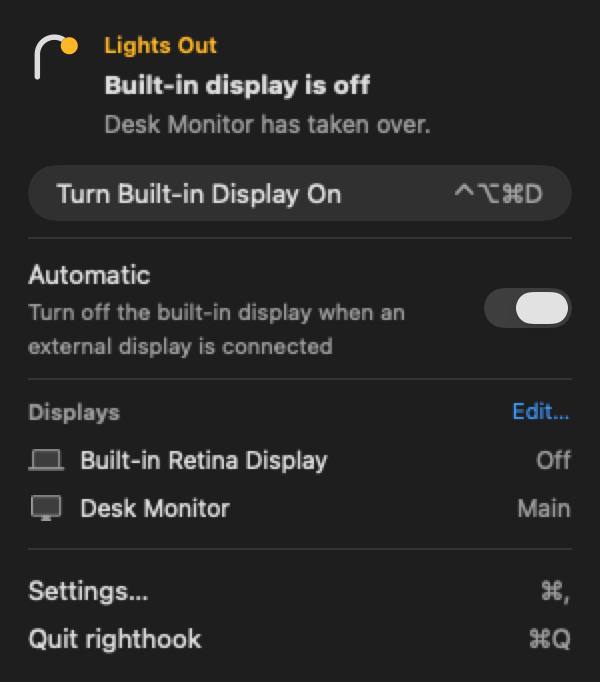
The righthook menu-bar panel. Eyebrow: Lights Out. Headline: Built-in display is off. Detail: Desk Monitor has taken over. Below it are a Turn Built-in Display On button, an Automatic switch that is on, a list showing the built-in display off and Desk Monitor as the main display, then Settings and Quit righthook.
The menu-bar panel says what’s happening at a glance, and gives you one click to change it.
The Sight Check panel on an external display. It asks Can you see this?, explains that righthook turned off the built-in display, and shows a 15-second countdown, a Remember this display checkbox and two buttons: Turn It Back On and Keep It Off.
Sight Check asks “Can you see this?” the first time a display is new. No answer, and your built-in display comes back.

Private by default. Nothing to configure.

  • Data Not CollectedThe App Store privacy label, and the truth.
  • No network accessrighthook can’t phone home. It has no way to.
  • No special permissionsNo Accessibility, no Screen Recording.
  • Public Apple APIs onlySandboxed, zero third-party code.

FAQ

Questions, answered plainly

Why not just close the lid?

You can. It’s called clamshell mode, and it works well if you’re happy to give up the laptop itself. Close the lid and the built-in keyboard, trackpad, Touch ID sensor and camera go with it. righthook is for people who want the lid open: type on the built-in keyboard, unlock with Touch ID, take calls on the built-in camera, and still look at only one screen.

Is the built-in display actually powered off?

No, and we won’t claim it is. righthook makes the built-in display go dark and moves everything to your external display, using standard macOS display features rather than anything that touches the hardware’s power. On some MacBook models you may notice a faint glow in a dark room. If you need the panel physically off, closing the lid is the way to do it.

Does it work with multiple monitors?

Yes. With two or more external displays connected, righthook turns the built-in display off and hands its job to one external display. By default that’s your main one, and you can pick a different one in Settings. Your other external displays carry on exactly as they do now. You can also tell righthook to ignore particular displays, so a TV you plug in now and then never triggers anything.

What if my external display isn’t showing anything?

That’s what Sight Check is for. The first time a new display would cause the built-in display to go dark, righthook shows “Can you see this?” on that display. If you can’t see it, because of a wrong input, a sleeping display or a flaky cable, just wait: after 15 seconds your built-in display comes back, and righthook leaves it alone until your displays change. You can also press Esc to bring it back at once.

If a display you’ve already confirmed stops showing anything, press your Comeback shortcut (Control-Option-Command-D unless you’ve changed it). It works from anywhere and doesn’t need you to see or click anything. And if macOS stops seeing the display altogether, righthook restores the built-in display straight away. More in Support.
What happens if righthook quits or crashes?

Your built-in display lights back up. righthook darkens the built-in display with a standard macOS display setting that macOS itself resets when the app that applied it ends, whether that’s a normal quit, a force quit or a crash. We test this on purpose by force-quitting the app while the built-in display is off. Quitting righthook from the menu restores everything right away, too.

Does righthook collect data or ask for special permissions?

No data, no network, no accounts. righthook is sandboxed, has no network access at all, includes no analytics or third-party code, and its App Store privacy label is Data Not Collected. It doesn’t ask for Accessibility, Screen Recording or any other special permission. Your preferences and the list of displays you’ve confirmed stay on your Mac. The full detail is in the privacy policy.

Which Mac models and macOS versions does it support?

MacBook Air and MacBook Pro running macOS 14 Sonoma or later, including macOS 26 Tahoe, on Apple silicon and Intel. righthook works with the external displays macOS itself manages. We haven’t tried every dock, adapter and KVM switch, so if yours behaves oddly, Sight Check and the Comeback shortcut keep you safe, and we’d like to hear about it at contact@unnecessaryapp.com.

What about presenting on a projector or TV?

righthook stays out of the way. If a projector or TV is mirroring your built-in display, which is what happens when you present, righthook leaves the built-in display on.

If the projector is set up as a separate display instead, righthook treats it like any other external display. To keep the built-in display on while that projector is connected, switch it off in Settings → Displays. The Comeback shortcut (⌃⌥⌘D) brings the built-in display back at any time.

Lid open. Screen off.

One less glow at your desk, and nothing you have to remember to undo.

Coming soon to the Mac App Store

For MacBook Air and MacBook Pro. Requires macOS 14 Sonoma or later. Apple silicon and Intel.

Questions? Visit Support or read the privacy policy.